I have really liked the work that Robert Kaplinsky does. Especially his videos depicting student thinking. The latest ones deal with the concept of deep understanding. The idea that students might have a working mechanical knowledge of math but when things go a little differently from the norm, misconceptions reveal themselves. Here he first asks students to calculate the perimeter and area of a rectangle. These are grade 8 students that should easily be able to do this and as the videos show, they can. But the important part comes when he asks the follow up question "List the dimensions of a rectangle with perimeter 24 units? ". Students then struggle. So the conversation is about what it means for a student to have a deep critical understanding of a concept (and that just having students mechanically doing math is not good enough). Check out the whole post here.
Curriculum Tags: All http://robertkaplinsky.com/why-depth-of-knowledge-is-critical-to-implement/
A few weeks ago I mentioned Michael Fenton's Match My Line/Parabola Desmos activities. He has an updated post on the match my line version with samples of student work and different versions (including a paper & pencil version). Even though it's the same activity, I like it so much I thought I would mention it again. The focus here is how to create your own versions.
Curriculum Tags: MPM1D, MFM2P http://reasonandwonder.com/match-my-line-%E2%80%A2-create-your-own/
More work from Michael Fenton. This time using one of my other favourite resources, visualpatterns.org. It's a neat workflow for students to start with the first three terms of the pattern and work towards the equation of the relation, using paper and pencil, a foldable and Desmos in between. This same workflow could be modified slightly for grade 7&8 students by just removing the equation component.
Curriculum Tags: Gr7, Gr8, MPM1D, MFM2P http://reasonandwonder.com/visual-patterns-desmos-amazing/
I like this one from Jon Orr asking whether Lego are gender biased. It's a big activity. Students have to collect data (from the web) about various Lego sets, their number of pieces and cost (from various themes - Starwars, Disney etc). Then they calculate the unit rates, graph the data and then try to answer the question about gender bias. Take a look
Curriculum Tags: MPM1D, MFM1P, MDM4U, MAP4C http://mrorr-isageek.com/?p=3736
I know it's not Pi Day yet. But this year's Pi Day is a one-in-a-century event 3-14-15 at 9:26:53 won't happen again until another 100 years has passed. So here's a link to my Pi Day Pinterest board (which I will probably post again next week)
Curriculum Tags: All https://www.pinterest.com/davidpetro314/pi-day/
I haven't featured anything from the 538 blog in a while. So here are a couple. The first one is a neat data set exploring the relationship between a TV show and its spin off. That is, whether the number of episodes that a series has is connected to the number of episodes its spinoff has. Perfect for doing everything from having students interpret the meaning of points on a scatter plot. It's not so great for something like a line of best fit (unless you want to talk about something with no relationship) but still interesting.
Curriculum Tags: Gr8, MPM1D, MFM1P, MDM4U, MAP4C http://fivethirtyeight.com/features/how-long-can-a-spinoff-like-better-call-saul-last/
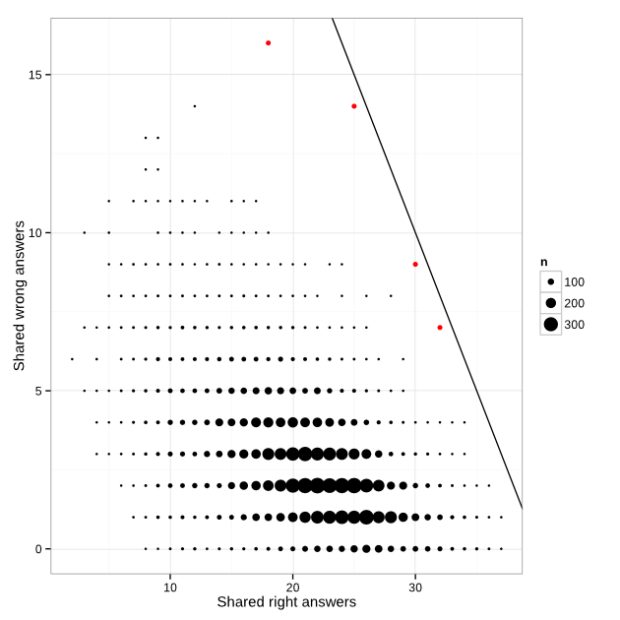
Though technically not from 538, this was pointed out on their site. This neat analysis of student responses on multiple choice tests to determine whether they have cheated. Students results were paired up and when they got the same answers for each question. The results were the graph seen below. Can you pick out the cheaters. Spoiler alert, the line represents a perfect match for two tests.
Curriculum Tags: MDM4U http://flowingdata.com/2015/02/25/identifying-cheaters-in-test-results-a-simple-method/
When I saw this I thought it was great. We have done such a good job of mechanizing the solution process for students that they no longer try to make sense of the actual problems we give. In this video 32 students are asked the question "There are 125 sheep and 5 dogs in a flock. How old is the shepherd?" Only a quarter of the students asked actually understood that this was unsolvable in its current form. The rest gave a numerical answer. It was originally discussed in a paper in 1993. This video is from Robert Kaplinsky but the blog post below expands on it further. The issue is that most students (about 75%) will try to do some math with this non sensical question. That is, most do not make sense of the question, they just assume they have to do some math and just try to hammer it out regardless of how realistic it is. I think everyone should try this experiment in their classes and see what your students do. If you get similar results then I think that only confirms what I suspect. That we do a good job of creating robot math students who really don't think about what they are doing.
Curriculum Tags: All http://tjzager.wordpress.com/2014/10/18/making-sense/
This kind of took the Internet by storm this week. Just released, Photomath boasts the ability to look a mathematical expression, recognize what it is saying and then simplify and solve it. If it works then this will drastically change how we assign homework. The problem is that it doesn't work all the time. Sometimes it doesn't recognize symbols other times it actually gets the math wrong. Watch the video below to see what it is supposed to do. It looks pretty impressive. Well I tried to test this thing out with the expressions seen on the right. For the most part it did alright, it calculated the answer then show the steps (though not always the most efficient steps). However, for the last question, it interpreted the question correctly then started solving it correctly but then the wheels quickly fell off when it dropped a bracket and interpreted a 2 in front of the missing bracket as the whole number 2 (as in a mixed fraction) instead of multiplying by 2. Thus getting the wrong answer. You can see Dan Meyer's post on this with a good discussion in the comments including my comment (#15) with images of this error here and here. Dan later tweeted my example of a mistake out and that conversation can be found here. And that tweet was used by the NY Daily News when they interviewed him about it here.
Curriculum Tags: All
We continue to add to our Engaging Math blog (in fact we just presented it at the When Faith Meets Pedagogy conference today) and I'll high light a couple here now. The first was another Tarsia puzzle. I talked about these last week and as we continue to create them I will post them here as well. This time the topic is multiplying and dividing by powers of 10. Everyone we show these seems to really like these puzzles.
Curriculum Tags: Gr8 http://engaging-math.blogspot.ca/2014/10/tarsia-puzzle-multiplying-and-dividing.html
Another one is an open sort dealing with similarity and congruence. In this one students are each given a card with a set of shapes, figures or pictures on it. They are then asked to sort themselves by using any criteria they want. That is what makes the sort open. Eventually the hope is that (with a little prodding, they get to the fact that there are two groups, similar figures and those that are congruent.
Curriculum Tags: Gr7, Gr8 http://engaging-math.blogspot.ca/2014/10/an-open-sort-dealing-with-similarity.html
A new activity from Mathalicious. This one dealing with solving solving and graphing quadratics. Their lessons are always awesome. This one takes the classic profit/cost type question and brings in a Nintendo flair. To get more from Mathalicious, you need to become a member but the cost of that is actually quite minimal. So consider it.
Curriculum Tags: MPM2D, MCR3U, MCF3M http://mathalicious.com/lessons/wiibates
This one is an online app that takes the scenario of shopping for some toys and turns it into a question about discounts and tax. the app is a bit crude but it could be useful for gr7 & 8 students as well as MAT1L/2L students. Thanks to Tiffany Hayes for this one
Curriculum Tags: Gr7, Gr8, MAT1L, MAT2L http://www.mathplayground.com/percent_shopping.html
For a while there I couldn't stop playing 2048 (I have gotten over it). My daughter, however, found this version that has you trying to build the Fibonacci Sequence. So instead of trying to get numbers that double you are trying to get consecutive Fibonacci Numbers. Fun and perfect for patterning.
Curriculum Tags: Gr7, Gr8, MPM1D, MFM1P http://www.coolmath-games.com/0-2048-fibonacci/index.html
We used this one as a Minds on a recent blog post from Engaging Math. A great starter for dealing with proportional reasoning and scatter plots. Have students ask questions about this or you ask "How tall would the person be that would fit in this shoe?" then go on to talk about proportional reasoning and ratios or scatterplots (connection between foot size and height - if any)
Curriculum Tags: Gr7, Gr8, MPM1D, MFM1P, MDM4U, MAP4C http://www.shoppedornot.com/wp-content/uploads/2011/02/giant-shoe-on-truck.png


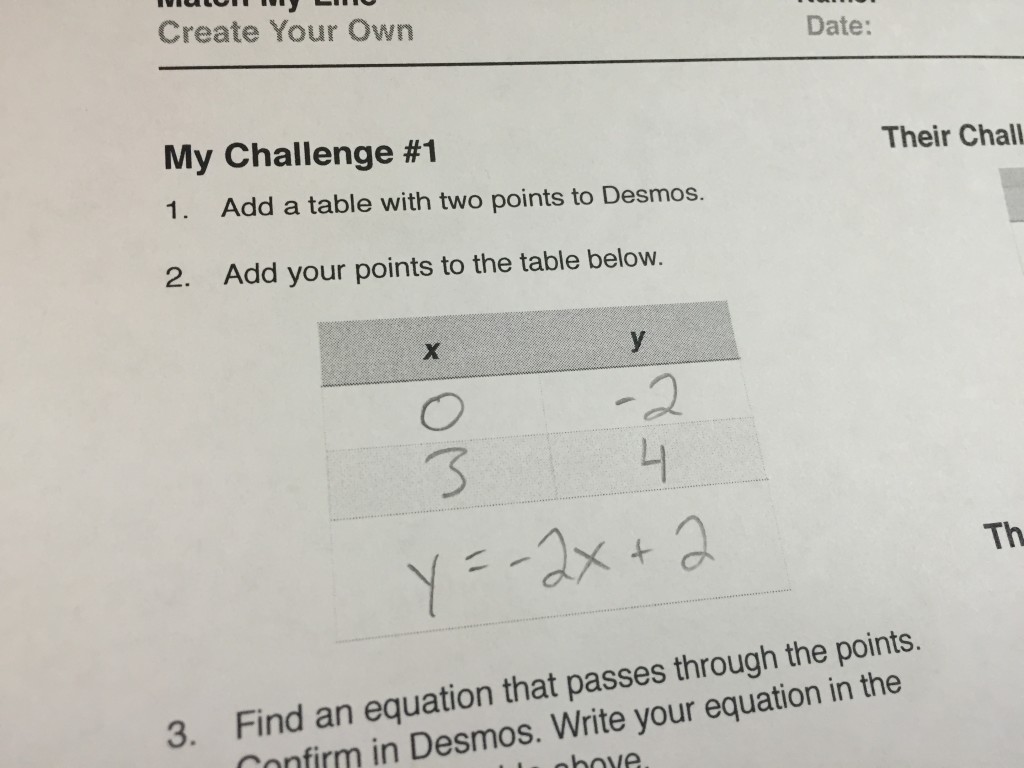 A few weeks ago I mentioned Michael Fenton's Match My Line/Parabola Desmos activities. He has an updated post on the match my line version with samples of student work and different versions (including a paper & pencil version). Even though it's the same activity, I like it so much I thought I would mention it again. The focus here is how to create your own versions.
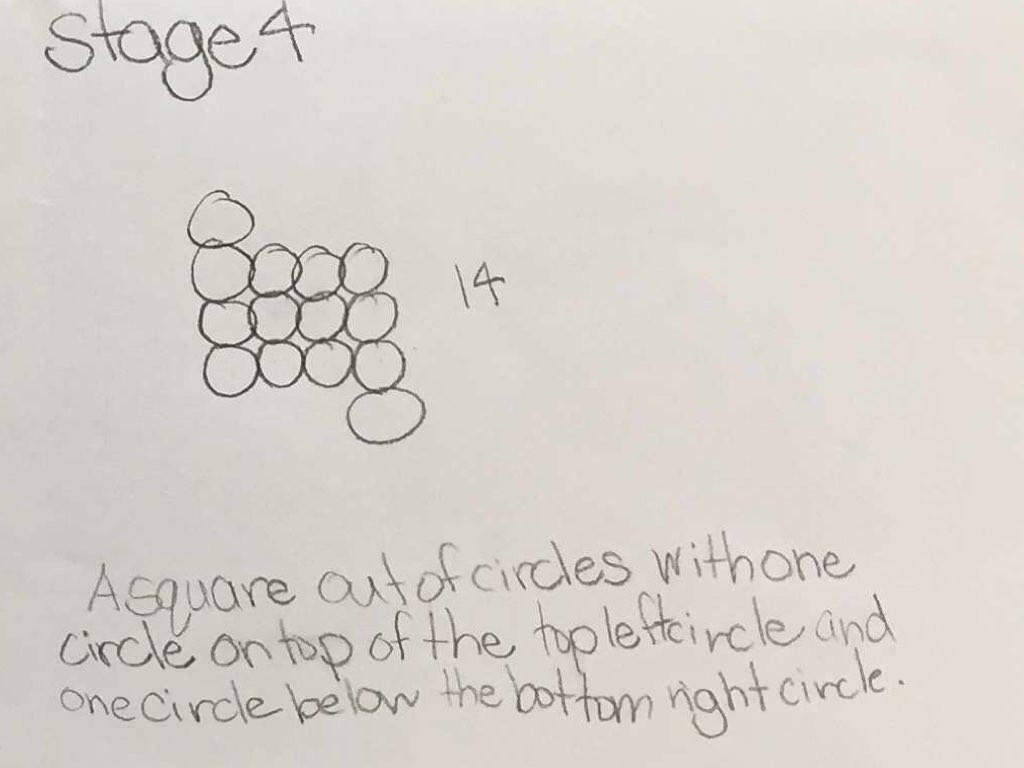 More work from Michael Fenton. This time using one of my other favourite resources, visualpatterns.org. It's a neat workflow for students to start with the first three terms of the pattern and work towards the equation of the relation, using paper and pencil, a foldable and Desmos in between. This same workflow could be modified slightly for grade 7&8 students by just removing the equation component.
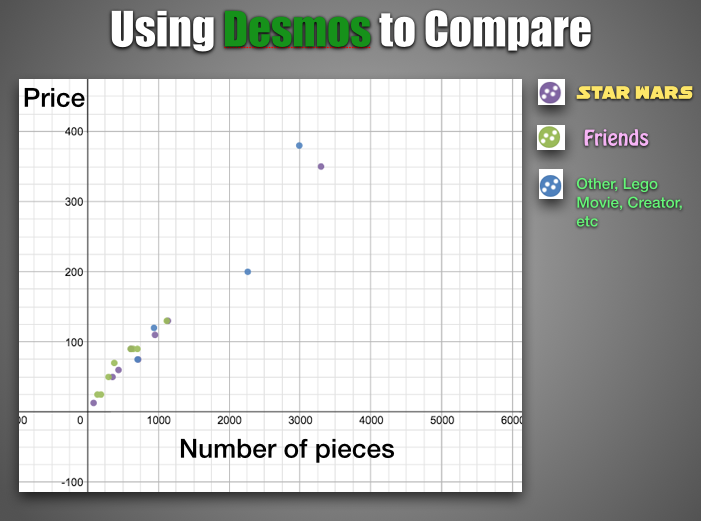 I like this one from Jon Orr asking whether Lego are gender biased. It's a big activity. Students have to collect data (from the web) about various Lego sets, their number of pieces and cost (from various themes - Starwars, Disney etc). Then they calculate the unit rates, graph the data and then try to answer the question about gender bias. Take a look
 I know it's not Pi Day yet. But this year's Pi Day is a one-in-a-century event 3-14-15 at 9:26:53 won't happen again until another 100 years has passed. So here's a link to my Pi Day Pinterest board (which I will probably post again next week)