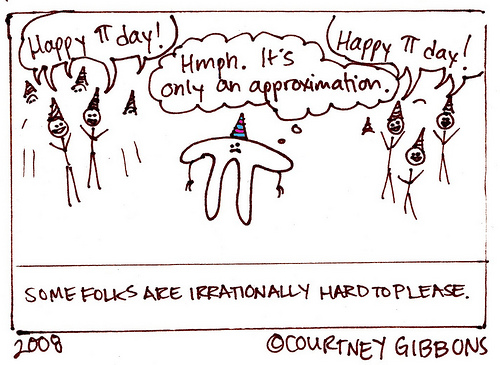
Key Curriculum, the maker's of Sketchpad, have really started to include a lot of web based sketches (ie no Sketchpad needed) in this one they have several different derivations of Pi using geometric and dynamic means.
Curriculum Tags: Gr8 http://blog.keycurriculum.com/2014/03/%CF%80-day-2014/
Keith Devlin has written a lot about Fibonacci and he has now put out a new video debunking a lot of the myths about the Golden Ratio and Fibonacci.
Curriculum Tags: All https://vimeo.com/88132964
Here is a neat little poster that talks about different types of numbers. It could be good to start some discussions on what characterizes a number. Thanks to Edudemic for this one.
Curriculum Tags: All http://www.incidentalcomics.com/2012/01/meet-numbers.html
Seeing as Pi Day is in a week I thought I would put my annual Pi Day post up a bit early. This just comes from my Pinterest Pi Day Page. My favourite video is below. Enjoy. Keep in mind that next year's Pi Day will be even more special since it will be 3.14.15
Curriculum Tags: All http://www.pinterest.com/davidpetro314/pi-day/
I like this recent post from the Tap Into Teen Minds blog on the importance of conceptual understanding (not just memorization) there has been a lot of discussion of this in recent months so it is quite topical. I especially like the nod to algebra tiles.
Curriculum Tags: Gr7, Gr8, MPM1D, MFM1P, MPM2D, MFM2P http://tapintoteenminds.com/2014/03/02/striving-for-deeper-understanding-and-retention-in-math-class/
Combinations with a connection to data management in one of the latests posts from Yummy Math. First determine the number of different types of hot chocolate you can make then see which one is the "healthiest"
Curriculum Tags: MDM4U http://www.yummymath.com/2014/too-early-in-the-day-for-so-many-choices/
Five year olds can learn to do Calculus. It sounds outrageous but if you are talking about the fundamentals of what calculus is, pattern recognition, then absolutely. Recently I posted an article stating that you never learned math in high school, this article seems to suggest that the opposite can happen.
I think my favourite quote from this article is
The one side says, “drill and kill.” The other says “drill for skill.” Basically, though, just about every mathematician and math education researcher who was interviewed for this story agrees that the perfect math class should have a mix of skills and problem solving. They just can’t agree on the amounts of each, when to add them, and what to skip.
Probably the most well researched and balanced articles in the "math wars" lately came from the Globe and Mail this week. Definitely well worth the read. There are two quotes I liked the most in this, both from Marian Small. The first one refers to the idea that often teachers teach the most efficient method for doing a problem but what is efficient for them may not be the most efficient for all students:
Dr. Small is showing a third option for two-number multiplication when a father raises his hand and asks: “But what’s the most efficient way?” “What’s your definition of efficient?” Dr. Small responds. “I think it’s probably the calculator.” When a few parents chuckle, she clarifies, “that was only half a joke.”
And I also liked the quote about claiming to not like math or not be good at math. It is a problem that we have with parents.
If you don’t like math, keep it to yourself.” Don’t tell your kids, you were bad at algebra or hated fractions, she explains, cause you’re giving them permission to be the same way.
On Mike's Math Page, he wrote about a recent Ed Frenkel's Op Ed which was basically the same as his Numberphile video on why people hate math. You can follow all of those links to refresh your mind if you wish. But the thing that Mike reminded me of is this great Richard Feynmen segment where he talks about the problem with math (specifically about algebra)
Curriculum Tags: All https://www.youtube.com/watch?v=VW6LYuli7VU
I thought this was a great image of one of the early MacDonald's menus. Not sure from what year but It think you could use it to see if the prices have all proportionally increased since then. Thanks to @thescamdog for this one.
Curriculum Tags: Gr7, Gr8, MPM1D, MFM1P https://twitter.com/thescamdog/status/439551795388379136/photo/1
At first glance I wasn't sure about this new 3Acts from Dan Meyer but then I got to the end of this video and totally loved it. So good for anyone teaching ratios. And I love the text messages a la Sherlock (as a nice added touch). Now to get the full 3Acts files you will have go to Dan's 101qs.com site and become a member but its worth it.
I am always looking for data and professional sports has a wealth of it. Especially now that they are making the bulk of it public. Check out the data that can be found here on this site from the NBA. So many different types of data that surely would be of interest so some young boys (and maybe some girls too). I really like the visual nature of the graphs. For example this one comparison graph can be customized for any number of stats and it always comes up with player pictures and definitions in real time. Thanks to Emergent Math for this one.
Curriculum Tags: Gr7, Gr8, MBF3C, MAP4C, MDM4U
Do you need data to show that it is a better deal to buy a bigger pizza instead of a smaller one? How about 74,476 data points. I really have to learn how to program in Python. So many cool things that you can do. Anyway, if you want a cool use of data or a connection to area of a circle, here you go. Complete with interactive graph. And then if that data isn't enough they have collected pizza price data by US city. See that here.
Curriculum Tags: Gr8, MAP4C, MDM4U http://www.npr.org/blogs/money/2014/02/26/282132576/74-476-reasons-you-should-always-get-the-bigger-pizza
From Yummy Math comes a post about movie ticket prices over the years. Movie data is one of my favs. Especially when you couple ticket price data (from Box Office Mojo) with box office record data like the top grossing films of all time (from Movieweb) . Because the thing about records like that is that they will likely always be broken for two reasons: 1) ticket prices will always go up (so less tickets need to be sold to accumulate the same total) and 2) there are more people available every year to go to movies.
Curriculum Tags: Gr7, Gr8, MBF3C, MAP4C, MDM4U http://www.yummymath.com/2014/cost-of-movie-tickets-over-time/
I know the show Numb3rs has not been on the air for years but that doesn't mean you still can't use it to make connections between math curriculum and the show. And so here are a couple of sites that take every episode and connect it to the actual math used.
Curriculum Tags: All http://numb3rs.wolfram.com/ http://www.math.cornell.edu/~numb3rs/
One of the expectations in grade 9 math is to develop the formula for the volume of a pyramid. If you have the proper manipulatives then its easy. If you don't then this video will do the trick (too bad the music is a bit cheesy). Thanks to Erina Shkodra for this one.
Curriculum Tags: MPM1D, MFM1P https://www.youtube.com/watch?v=OUDjY6vJ8pw
The connection to math may not be obvious right away for this one but I think all of the double negatives means you could use this to simulate multiplying by negative one repeatedly and thus either have a positive or negative answer. Thanks to Dale Wilson for this one
Curriculum Tags: Gr8 https://www.youtube.com/watch?v=6CGyASDjE-U
This clip from the movie Pay it Forward could be a great introduction to exponential growth. Whether it be in Grade 8 or even as a minds on for dealing with exponential functions in grade 11 or grade 12. Thanks to Andrena Misener for this one
Curriculum Tags: Gr8, MCR3U, MAP4C, MHF4U http://www.youtube.com/watch?v=N0HTneOLrEc
This past week the Centre for Education in Mathematics and Computing held its annual grade 9, 10 & 11 math contests (Pascal, Cayley & Fermat). They are great contests and you can see the archives here. I really like how they are written so that just about any math student can find some success but only the best can get them all right. That being said, one nice feature on the site is their Problem of the Week. They have a set for grades 5/6, 7/8, 9/10 and 11/12 that they create. Sign up to get them emailed to you each week.
Curriculum Tags: All http://cemc.uwaterloo.ca/resources/potw.php
How to Learn Mathematics: for Teachers and Parents is an online course created by Joe Boaler from Stanford. Based on the latest research, this is the new version of last year's How to Learn Mathematics. By all accounts last year's course was awesome (I just didn't have the time in the summer to take it). This year one of the differences is that it's not free ($125). The course is self paced and you have any time between June 15th and Sept 15th to complete it. The course is made up of 8 sessions and it is anticipated that each will take 1-2 hours. As the title suggests, this is for teachers and parents but eventually there will be a course for students as well. For more info, follow the link.
Curriculum Tags: All http://scpd.stanford.edu/instanford/how-to-learn-math.jsp
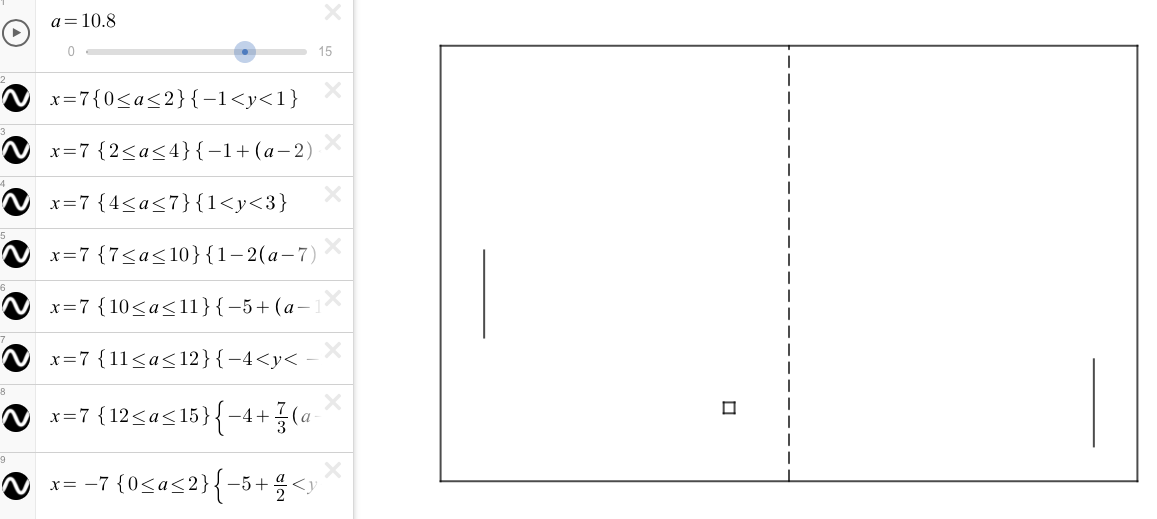
More in the "why I like Desmos" series. They have done a lot to making the boringness of domain and range a lot more interesting for students. And this time here is an example that combines both domain & range and transformations. That is, an animated version of Pong.
Curriculum Tags: MCR3U https://www.desmos.com/calculator/3imoiky3uv
Its been a few years since I have done this but its worth mentioning. The Barbie Bungy is a great activity. It has shown up many places on the net and here is the latest (with mention to some of the others). The perfect activity for when you need to have a fun way to look at scatterplots and extrapolation.
Curriculum Tags: MFM1P, MPM1D http://mrvaudrey.com/2014/02/15/barbie-bungee-2014/
Forget Moneyball and Big Data and watch out Nate Silver, the punch cards are coming. Not sure how real this is but its got that kitchie 50s feel that using data to model basketball game play only could have.
Curriculum Tags: MDM4U https://www.youtube.com/watch?v=dhh8Ao4yweQ
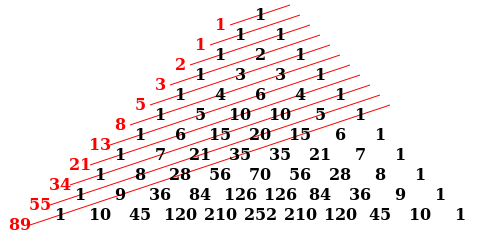
I like this Tumblr for images that help visualize mathematics. Some cool stuff here. Some are animated gifs, others have information to go with them. I like this one that Dan Meyer pointed out about the connection between Fibonacci and Pascal's Triangle.
Curriculum Tags: All http://visualizingmath.tumblr.com/
I love this graph about how Lego's revenues have increase since it started licensing characters from movies that is made out of Legos
Curriculum Tags: Gr7, Gr8, MBF3C, MDM4U, MAP4C http://www.wired.com/underwire/2014/02/infoporn-legos/
Trig identities a can be and issue as their abstractness can be a hurdle for many kids. Don't get me wrong, I think it's important for our kids to be able to work in abstractions but if there are ways to make topics less abstract than they need to be, then I think that's a good thing. That is why I like this post about a graphical way to get to the Pythagorean trig identities. Well done.
Curriculum Tags: MCR3U http://samjshah.com/2014/02/10/trigonometric-pythagorean-identities/
I love learning stuff about things I like. For example, to day I learned you can import pictures into Desmos from Mary at the M^3 blog. I love doing this with Geometer's Sketchpad (my premade sketch is here) but now that I know Desmos does it that gives a nice alternative. Although I do like my sketch because it has a feature to scale the axes so that the equation actually has a connection to real measurements. So take a look at this blog post and if you want some more images to use, you can look at some I have collected here.
Curriculum Tags: MFM2P, MPM2D, MCR3U, MCF3M, MBF3C http://marybourassa.blogspot.ca/2014/02/mfm2p-day-6.html
There is nothing like a real contextual problem to expose the problem people have with probability (a lot of "prob's" in that sentance). Here is the context. You are taking a medical test that is 95% accurate when people have the disease (in this case cancer). So this means there are 5% false positives. If your results come back positive, should you be concerned? The counter intuitive result is "no". John Allen Paolos wrote about this 4 years ago (and just retweeted it now) in the context of mammograms. So here's the scenario: 95% accurate when people have cancer, 99% accurate when people don't have cancer and assume that 0.5% of the 100,000 person population actually have cancer. I will leave it up to you to do the math or you can just click on the link below.
Curriculum Tags: MDM4U http://www.nytimes.com/2009/12/13/magazine/13Fob-wwln-t.html?_r=3&emc=tnt&tntemail1=y&
I think one of the best things you can do for students is not give them the answers. To take Dan Meyer's tag line "less helpful". I realize that this is totally counter intuitive to teachers. Most of us got into teaching because we like telling people how to do stuff. So when a kid asks a question (or gives an answer that is wrong), it is a natural reaction to just give them the answer (or just say 'nope'). But why not, instead, lead them to the answer or at least have them reveal their thinking (even when they are correct). That is why I like this post from Andrew Stadel so much. It gives tips on how to approach those situations in ways that will best benefit the student.
Curriculum Tags: All http://mr-stadel.blogspot.ca/2014/02/explain-that-please.html
For any of you teaching conversion from metric to imperial (and vise versa), this video from Matt Parker gives a nice overview of the logic behind the imperial system.
Curriculum Tags: MFM2P, MBF3C, MAP4C https://www.youtube.com/watch?v=r7x-RGfd0Yk
Function Carnival is a new set of activities developed by Desmos with the help of Dan Meyer and Christopher Danielson. With these "Students watch a video. They try to graph what they see. Then they play back the video and see how their graphical model would be represented as an animation." These are great activities that provide a nice way to look at position-time graphs. A few of the features I like are
the fact that you create a class and then give your students the class code (to be used on the site class.desmos.com). With this class code you can then see each student's individual graph(s).
there are three very different scenarios (including a sinusoidal case) and each of the scenarios have an extension where students are asked what is wrong with a particular graph
the fact that they deal with graphs that are not functions (see image).
Given the different types of graphs I could see using this in classes that range from graphing in grade 7 to functions in grade 11. Not sure if more scenarios are on the horizon but check out Dan's post for a discussion around that.
Curriculum Tags: Gr7. Gr8, MFM1P, MPM1D, MFM2P, MCF3M, MCR3U http://blog.desmos.com/post/74745817070/carnival
Holy flashback, Batman. It seems like such a long time ago that I worked on developing this resource with Mary and as it turns out it was a decade. It was a pretty polished product by the end with activities for several different classes and a DVD with live action from the classroom. This activity was a great on for developing sinusoidal function proficiency with grade 11 students. It was written with the last incarnation of the curriculum in mind (not the current) but it is still relevant. It's been a while since I taught MCR3U so perhaps that is why I forgot about it but I loved working with the CBRs with my students. Thanks for the reminder.
Curriculum Tags: MCR3U http://marybourassa.blogspot.ca/2014/02/going-around-in-circles.html
Its always good to be reminded that even our best students can benefit from activities that may not be traditional. And what better course than what tends to be the pinnacle of high school math courses. Here's a great way to help with curve sketching by using highlighters.
Curriculum Tags: MCR3U http://squarerootof.....math.blogspot.ca/2014/01/sketching-f-from-f.html
And if a little bit of Phi isn't enough, how about a classic: Donald in Mathemagic Land (the full movie). For a better version, click on the link instead of watching the embedded video here.
Curriculum Tags: All http://www.youtube.com/watch?v=U_ZHsk0-eF0


 Key Curriculum, the maker's of Sketchpad, have really started to include a lot of web based sketches (ie no Sketchpad needed) in this one they have several different derivations of Pi using geometric and dynamic means.
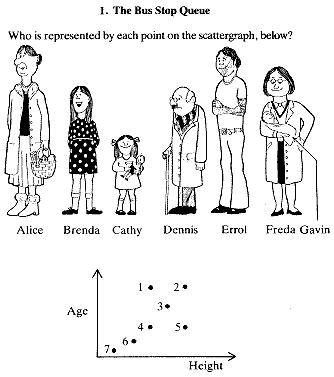 The Language of Functions and Graphs is a resource that might be old but there are a lot of great problems here for the picking. This used to be a paid resource but now its available for free in PDF form, both the black line masters and the teacher resource. Thanks to Michael Pershan and Dan Meyer for this one.